Selecting the right material is one of the most critical decisions in any engineering design or fabrication project. In CNC routing and milling, the choice of material dictates everything: tool speeds, machining time, cutter wear, part tolerance, and ultimately, the final unit cost.
At Replix3D, we machine a wide variety of materials. Here is a practical engineering guide to selecting between wood, engineering plastics, and metals for your CNC machined parts.
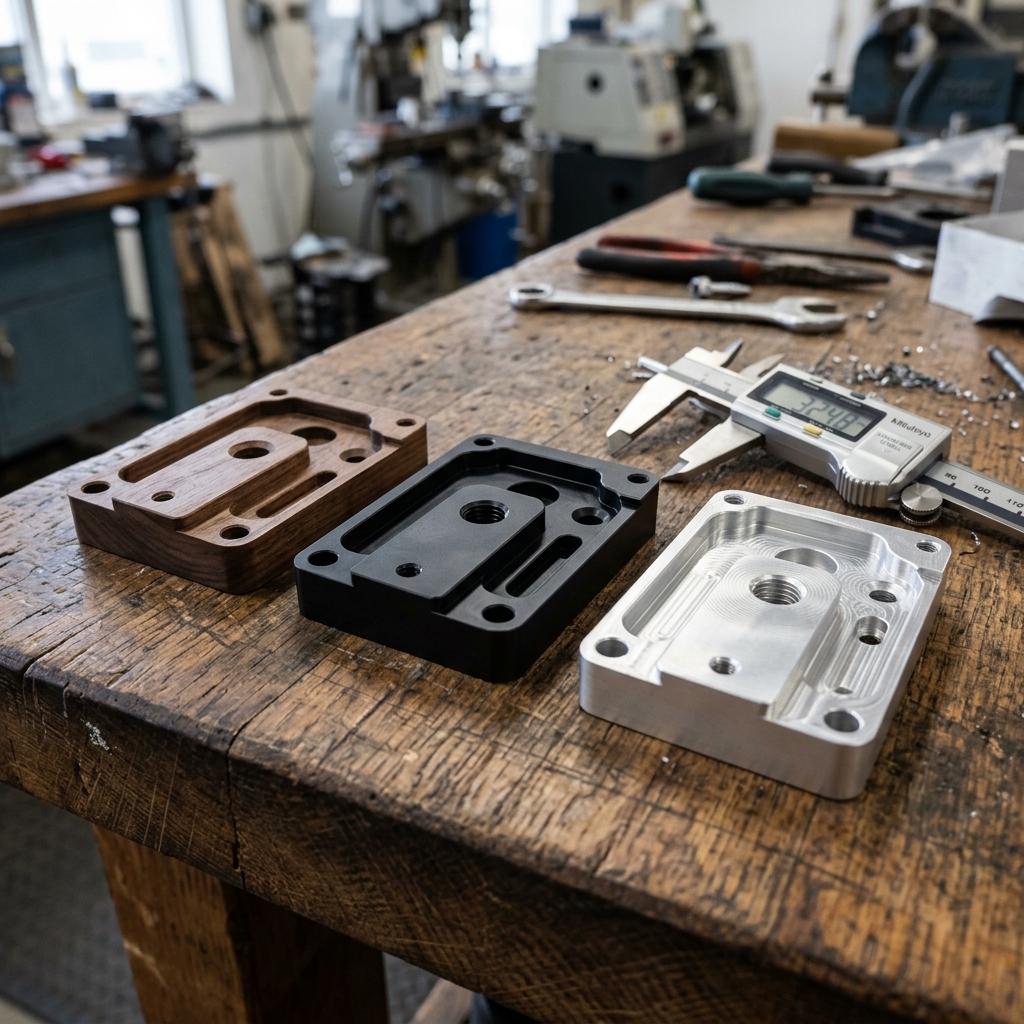
1. Wood: The Prototyping & Architectural Standard
Wood is the original CNC material, and it remains highly relevant for design models, architectural panels, and tooling patterns.
- Hardwoods (Walnut, Oak, Maple): Excellent for furniture, high-end signage, and presentation models. Hardwoods machine beautifully, hold crisp edges, and can be sanded and stained.
- Plywood (Baltic Birch): A structural powerhouse. Because of its cross-laminated layers, high-quality Baltic Birch plywood is incredibly stable, warp-resistant, and strong. Perfect for shop fixtures, speaker enclosures, and structural boxes.
- MDF (Medium-Density Fiberboard): The king of rapid prototyping. MDF has no grain, is perfectly flat, and is very cheap. It is the go-to material for vacuum clamping fixtures, mold patterns, and visual mockups.
2. Engineering Plastics: Precision and Low Friction
If you need precision parts with excellent sliding properties, insulation, or chemical resistance, engineering plastics are the perfect choice.
- Delrin / Acetal (POM): The absolute favorite of CNC machinists. Delrin is highly rigid, has excellent dimensional stability, and cuts like butter, leaving a beautiful burr-free finish. Ideal for gears, bushings, bearings, and slide blocks.
- HDPE (High-Density Polyethylene): Extremely durable, impact-resistant, and chemically inert. Since it is FDA-compliant, HDPE is widely used for food processing equipment, outdoor signage, and marine components.
- Polycarbonate (PC): If you need transparency and extreme impact resistance (it is the base material for bulletproof glass), polycarbonate is the standard. It is tougher than acrylic but requires careful machining to prevent stress cracking.
3. Aluminum: The Lightweight Metal Standard
When plastics aren't strong enough or wood isn't durable enough, aluminum is the logical step up.
- 6061-T6 Aluminum: The workhorse alloy. It offers an excellent strength-to-weight ratio, is highly corrosion-resistant, and machines incredibly well. It can also be anodized in various colors to add surface hardness and wear resistance. Perfect for mounting brackets, motor housings, and custom automotive components.
Material Comparison Matrix
| Material Class | Rigidity | Machining Ease | Impact Resistance | Cost |
|---|---|---|---|---|
| MDF / Wood | Low-Medium | Very Easy | Low | $ |
| Delrin (POM) | Medium-High | Very Easy | High | $ |
| Polycarbonate | Medium | Easy-Medium | Extremely High | $ |
| 6061 Aluminum | Very High | Medium | High | $$ |
Making Your Selection
When choosing a material, ask yourself these three questions:
- What are the environmental constraints? (Does the part need to withstand outdoor UV light, water, or high temperatures above 80°C?)
- What are the mechanical loads? (If the part needs to hold tight tolerances under load, choose aluminum or Delrin).
- What is the production volume? (For simple brackets, 3D printing in carbon-fiber filled filament might be cheaper for 1-5 units, whereas CNC milling in Delrin is faster for 10-100 units).
Need help choosing the right material for your next project? Check out our CNC Routing & Milling Services.